MOSS Energy Systems
Industrial steam, process heat, energy saving gasification, boiler and cogeneration systems. Contact us for info!.
MOSS Co - Energy Systems Division
MSW Fired Electrical System
Moss provides state of the art municipal solid waste (MSW) fired co-generation facilities meeting existing air emission regulations. Landfills are a major problem throughout the world. Landfill sites are just not ugly and smelly, unfortunately, they create many health and environmental problems. The United States EPA states that for every ton of garbage combusted at a municipal solid waste to energy facility, approximately one ton of carbon dioxide (CO2) is prevented from being emitted into the atmosphere. The reason: Because landfills are the largest emitter of methane in the United States. Methane is shown to be at a minimum of 30 times more potent a gas than CO2. Even though there is technology to capture methane in capped landfills, only about a third of the methane is used effectively by producing electricity. We have what we think is the best solution, which is recycling profitable waste and burning the balance in our waste to energy plants. By doing so, gases going into the atmosphere will be substantially reduced and the landfills life will be substantially extended.
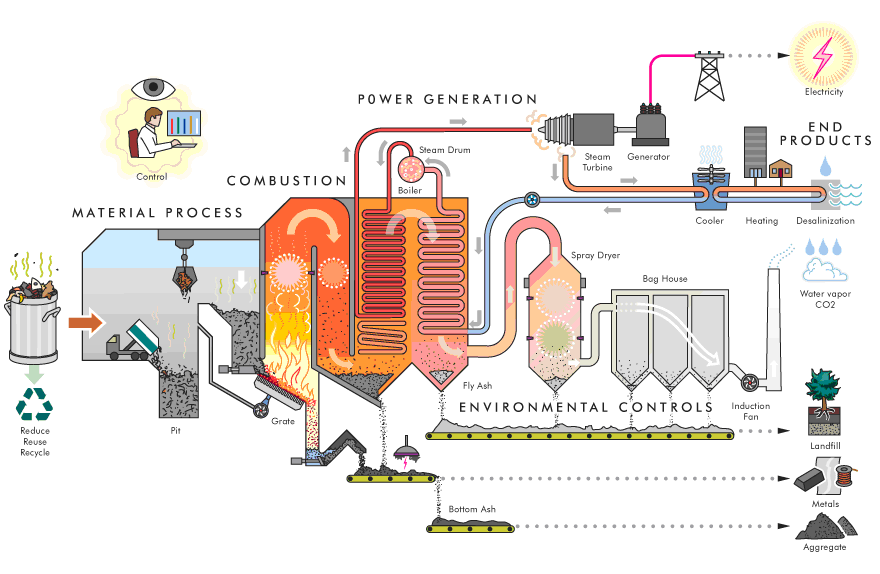
Below is a simplistic explanation of a Moss municipal waste to energy facility:
Waste is received by trash haulers in an enclosed receiving area and can be either dumped onto the receiving floor and then loaded directly into the combustion process or can be transferred to a recycling center. If the waste is not recycled, the waste will be transferred from the receiving area to a loading hopper for feeding into our combustion system. If recycling occurs, the waste will be transferred to the recycling equipment where plastic, glass, paper, metal and wood will be removed from the waste stream. This will reduce the carbon and pollutants created in the burn process. The remaining materials will consist of kitchen refuse, bio waste and commercial garbage. Waste streams from either process is blended in order to enhance the combustion process. As the mixed waste enters our combustion chamber, the fuel is constantly being transferred through the chamber in order to allow oxygen to be exposed to the waste and for automatic ash removal. This waste movement allows the waste to burn evenly and completely as it travels through the process. Moss creates a negative draft in the receiving building, which carries dust particles and odor into the combustion chamber from the receiving area (this design eliminate its spread outside of the MSW facility).
When processing municipal solid waste with the Moss waste to energy process, landfill volumes will be reduced by more than 90 percent. The Moss waste to energy process will prevent one ton of CO2 from being released into the atmosphere for every ton of MSW burned in addition to the reduction of the much more potent and toxic methane gas that would have been leaked into the atmosphere if the waste had been loaded into the landfill.
The Moss control system monitors and controls the entire process from loading the waste into the system through the stack exit to the ash haul-off. Loading the boiler facility with a homogeneous mixture of waste is critical to the combustion process. Once the fuel goes into the system, all phases of the system is automatic and is constantly monitored some as many as thousands of times a second. The entire process is monitored to optimize efficiency in the combustion, steam generation, electrical generation and environmental control processes.
Ash is captured throughout the process. The unburned remains from the combustion chamber is called bottom ash. This ash is passed by magnets and eddy current separators to remove both ferrous (steel and iron) and other metals such as copper, brass, nickel and aluminum. All of these metals can be recycled.
The finest airborne particulates are removed in a flue gas filter (baghouse) or electrostatic precipitator (ESP). The system includes an induction fan that pulls air from the furnace through the fabric bags or ESP toward the discharge stack. This particulate process removes 96 percent of any remaining ash particulates. These devices are vibrated on timed intervals in order to shake loose particulates that are caked on their inner and outer surfaces. Captured ash is returned to landfills or can be used as aggregate for roadbeds, rail embankments, concrete plants or other processes.
The flue gas system is provided with acid gas, heavy metal or nitrogen oxide removal equipment, as needed, to neutralize the flue gas before being emitted into the atmosphere. This along with the particulate removal meets or exceeds Federal, State or local air regulations.
Heat from the flame and high temperature gases are transferred into water inside the boiler tubes. This heat transfer creates highly efficient superheated steam that turns the steam turbine and generator to create electricity. Once the BTU's in the steam have been removed in the turbine system, the cooled steam is cycled back into water (condensate) through the condenser or diverted as a heat source for buildings. After all heat has been removed from the condensate, it is returned through the economizer and superheater to reheat the water to complete the steam cycle.
Once the electricity is produced in the turbine system, it is transferred to the electrical grid for use in the local community. For each ton of waste that is processed in a waste to energy facility can generally power a household for a month.